Settings and Publishing
When the survey content becomes stable, the next question is: how will this survey be filled and used in the real world?
In Wejot, settings and publishing are not just a final checklist. They are confirmed progressively as the research gets closer to real execution.
Settings determine runtime behavior, including who can answer, how they answer, and what constraints apply.
These settings do not change question content. They define how the survey “runs” in real usage contexts.
Settings typically revolve around:
- Identity and access: anonymous vs identified responses
- Behavior controls: copy/paste restrictions, duplicate submission limits
- Distribution rules: whether the survey can be shared
- Submission conditions: when submission is allowed or terminated
These are confirmed step by step as the study clarifies.
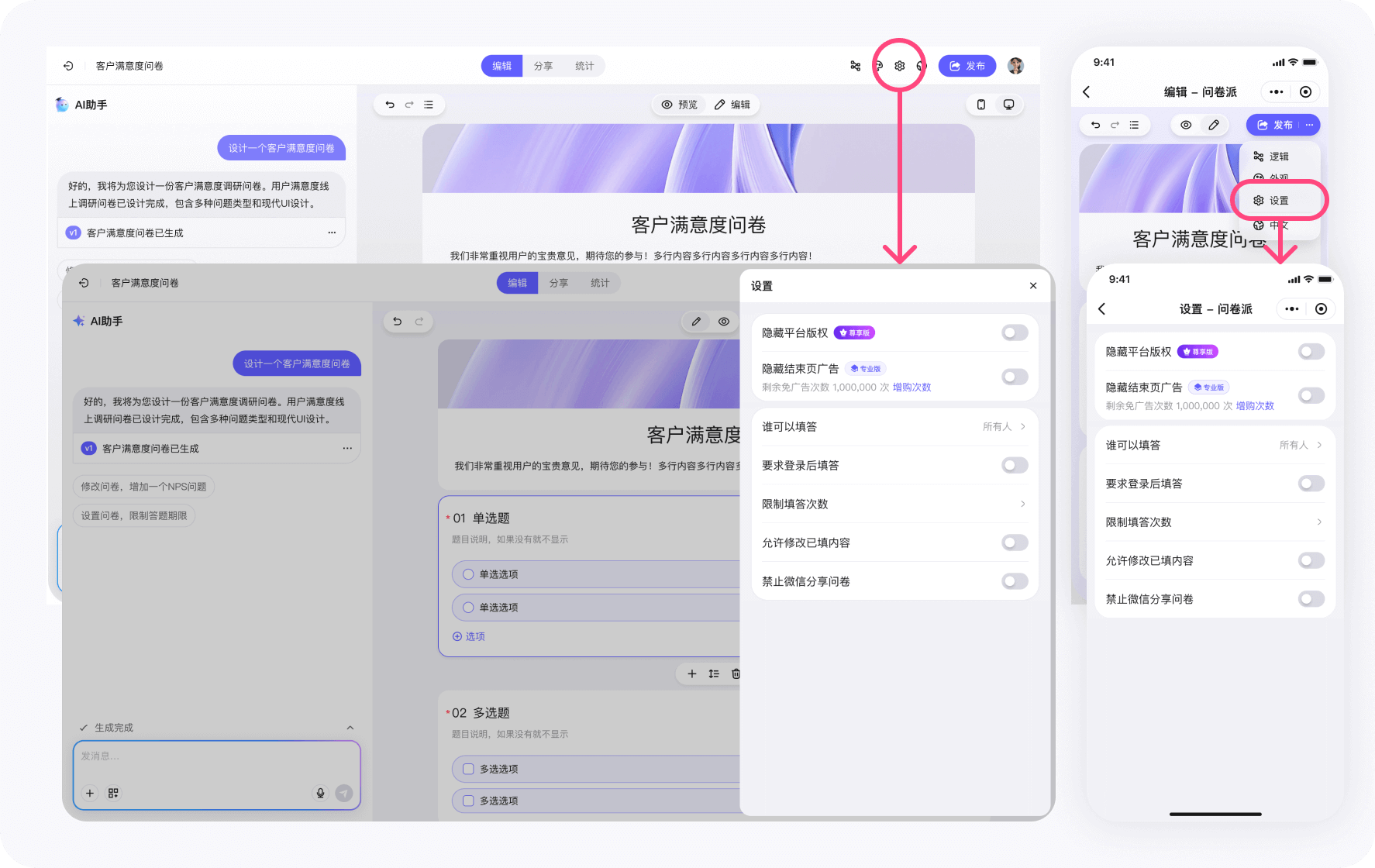
Below are common settings requests that can be used as input:
This survey must be filled with real identity.Disable copy and paste to reduce careless answering.Do not allow the survey to be forwarded via WeChat.Each user can submit only once.After settings are confirmed, you can publish the survey.
Publishing does not end the workflow. It means real respondents can start using the survey.
After publishing, you can still:
- Monitor response progress
- Adjust settings when needed
- Publish a new version
Once published:
- Respondents answer under the current settings
- All logic and validation rules take effect
- Data is collected continuously
If new decisions or needs arise, you can adjust through conversation and publish again.
Settings are not a one-time checklist. They evolve as the study gets closer to the real context.
As your understanding of target audience, data quality, and usage constraints deepens, settings are refined accordingly.
In many traditional survey platforms, you will see a long list of “settings”, for example:
- Show or hide question numbering
- Allow or block actions under specific conditions
- Set a maximum response cap
In Wejot, these are often not separate settings.
Because: most of them are expressions of logic.
With Wejot’s logic and script generation capabilities, many scenarios that used to require complex settings can be directly expressed as logic.
As a result, Wejot intentionally keeps fewer visible settings and keeps complexity inside the system—not on the user.