AI Helpers
The era of one AI burning the midnight oil on 100,000 rows of feedback is over. Wejot now puts a whole AI research team to work at the same time.
AI Helpers brings SubAgent collaborative analysis to data analysis in Wejot. Instead of a single agent muscling through massive datasets alone, the main agent now works like a research team: it splits the work across several “helpers” who run in parallel, then consolidates their findings into one answer.
Why helpers exist
In practice we found that many complex tasks just don’t fit a single agent:
- Tens of thousands of user comments, large bodies of open-ended responses, oceans of reviews and social chatter.
- The more data one agent ingests, the more its context bloats — attention drifts, and the model can simply fail.
- A single viewpoint also misses edge signals — the same feedback may need sentiment, pain points, tags, and trend reading all at once.
AI Helpers lets the system operate like a real team: someone analyzes, someone classifies, someone summarizes, and a lead aggregates at the end.
Where you’ll see it
-
The
/quick-action menu in the chat inputType
/in the input box. The Skill popover lists AI Helpers as a built-in entry at the top. Once selected, a “Helpers” tag appears in the input to indicate the current turn will delegate parallelizable subtasks to helpers.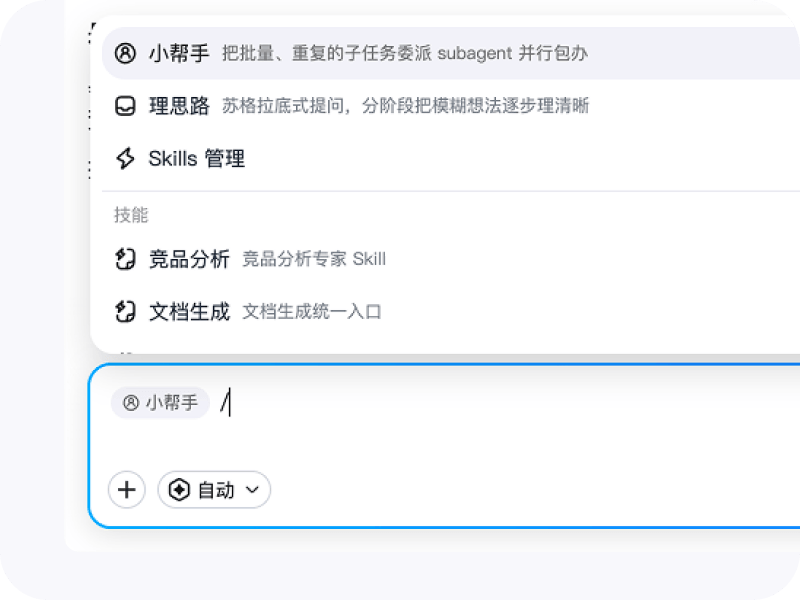
-
The “Helpers at work” group in the chat stream
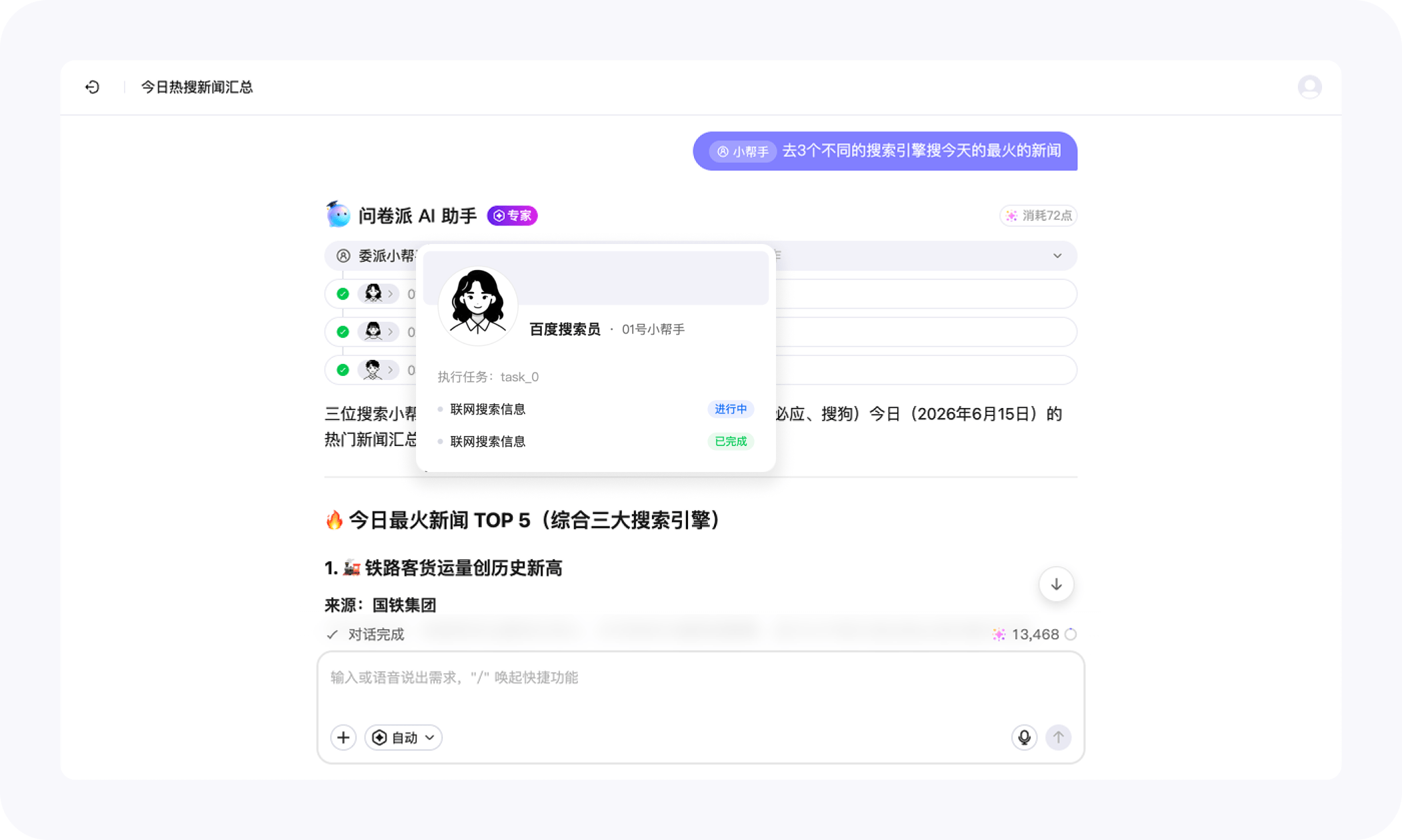
When the main agent dispatches helpers, a Batch Analysis block appears in the chat. Each batch corresponds to one helper:
- Every helper has its own number, avatar, and nickname (e.g. “Helper 01 · Searcher”).
- While running, a spinner shows what it’s doing right now (“Running text analysis”, “Data read complete — moving on”).
- When done, the helper gets a checkmark and its subtask list auto-collapses, handing off to the main agent for synthesis.
- Hover the avatar to open a helper info card showing the current subtask checklist with per-step status (Pending / In progress / Done).
How it works
AI Helpers is a multi-agent collaborative execution pattern:
- The main agent decomposes the task — slices a large analysis into parallelizable subtasks and picks the right helper role for each.
- Parallel delegation — every helper handles its slice in its own isolated context, preventing the context bloat and attention drift you’d hit if one agent did it all.
- Visible progress — each helper’s tool calls and stage updates stream into the chat in real time.
- Unified synthesis — once helpers finish, the main agent fuses the results and outputs conclusions, charts, even a full report.
Take 100,000 rows of VOC feedback as an example: one helper handles sentiment analysis, one extracts pain points, one assigns tags, one spots outliers, one summarizes trend shifts — and the main agent stitches their work together to surface trends, pain points, and latent needs from the raw text.
You decide who does what
AI Helpers is not a fixed pipeline. You can tell the main agent how to divide the work, for example:
- “Analyze from a product manager’s perspective.”
- “Focus only on churn reasons.”
- “Concentrate on high-value users’ needs.”
- “Find unmet needs that competitors miss.”
The main agent will split the task, define the right roles, and dispatch them to helpers running in parallel.
Thoughtful details
- Stable helper identity — within the same project, helpers with the same name share the same avatar; refreshing or returning to the session keeps avatars and numbers unchanged.
- Projects stay independent — each survey has its own shuffled avatar sequence, re-randomized on first appearance, so helpers in the same project never duplicate avatars.
- Stable streaming — every batch renders by a stable ID, so helpers don’t flicker or swap identity mid-stream.
- Auto-collapse on completion — once all helpers finish, their subtask lists collapse, keeping the chat tidy.
Who it’s for
If you’re working on:
- User research / VOC analysis — open-ended responses, interview transcripts, user feedback at scale.
- Market / competitor research — many dimensions or many competitors scanned in parallel.
- Data analysis — the same dataset that needs to be split across several viewpoints simultaneously.
- Opinion monitoring — large volumes of cross-platform comments, sentiment, and topic clustering.
Hand the work to AI Helpers and let a whole AI research team work in parallel — far more efficient than one model pulling an all-nighter over 100,000 rows.
How it relates to other capabilities
- Pairs with Clarify: use Clarify first to lock the research intent, then let AI Helpers execute the analysis in parallel.
- Pairs with Skills Management: helpers still call the enabled official / custom Skills (Text Analysis, Data Analysis, Document Generation, etc.) while running — you control the boundary of what they can do via Skills Management.
Wejot doesn’t just let AI handle your data — it makes multiple AIs work like a real research team: dividing labor, collaborating, cross-checking, and finishing the analysis together.